Understanding U.S. Customs Inspection Codes: What Importers Need to Know
For importers shipping goods into the United States, one of the biggest uncertainties is the possibility of a U.S. Customs inspection. Many importers suddenly receive notices showing mysterious codes such as 1H, 2H, 5H, CET, VACIS, Tailgate, or X-Ray, without fully understanding what they mean, how serious they are, or how much delay and cost they may cause.
In recent years, U.S. Customs and Border Protection (CBP) has significantly increased cargo screening and enforcement, especially for shipments involving e-commerce, bonded cargo, FDA products, anti-dumping concerns, and tariff-sensitive commodities.
This guide explains the most common U.S. import inspection codes and what importers should expect during the clearance process.
Why Does CBP Inspect Cargo?
U.S. Customs and Border Protection conducts inspections for several reasons:
- National security
- Trade compliance
- Intellectual property protection
- Anti-smuggling enforcement
- FDA/USDA/EPA regulatory checks
- Verification of declared cargo value and classification
- Detection of forced labor or sanctioned products
Inspections can happen randomly, but high-risk shipments are more likely to be targeted.
Common U.S. Customs Inspection Codes Explained
1H Exam — Customs Document Review
The 1H exam is usually the lightest level of inspection.
What Happens:
- CBP reviews shipping documents electronically
- No physical cargo inspection in most cases
- Customs may request:
- Commercial invoice
- Packing list
- Bill of lading
- Importer information
- Manufacturer details
Typical Causes:
- Incomplete paperwork
- HS code mismatch
- First-time importer
- Suspicious cargo description
Possible Delay:
- 1–3 business days
Cost Impact:
Usually low or no examination fee.
2H Exam — Non-Intrusive Inspection (NII)
The 2H exam generally refers to a scanning inspection.
What Happens:
Cargo is sent through:
- X-ray scanning
- Gamma-ray imaging
- VACIS scanning systems
CBP checks for inconsistencies between the declared cargo and the scanned image.
Typical Causes:
- High-risk routing
- Random targeting
- Dense cargo
- Electronics or machinery
- Mixed commodity shipments
Possible Delay:
- 2–5 business days
Cost Impact:
Terminal handling and transportation fees may apply.
CET Exam — Contraband Enforcement Team Inspection
The CET exam is more serious and enforcement-focused.
What Happens:
CBP’s Contraband Enforcement Team physically inspects the container for:
- Narcotics
- Weapons
- Smuggled goods
- Restricted products
Cargo may be partially unloaded.
Typical Causes:
- High-risk origin countries
- Smuggling intelligence
- Suspicious shipping patterns
- Seal irregularities
Possible Delay:
- 3–7+ business days
Cost Impact:
Higher inspection and devanning charges.
Tailgate Exam — Partial Physical Inspection
A Tailgate Exam is a quick physical inspection at the container door.
What Happens:
- CBP opens container doors
- Officers visually inspect accessible cargo
- Only front cargo may be checked
Typical Causes:
- Random inspection
- Verification of declared goods
- Seal verification
Possible Delay:
- 1–2 business days
Cost Impact:
Usually moderate.
Intensive Exam / 5H Exam — Full Cargo Examination
The 5H exam has become one of the most discussed inspections in the logistics industry recently.
What Happens:
- Entire container is moved to CES (Centralized Examination Station)
- Cargo is fully unloaded
- Cartons may be opened individually
- CBP performs detailed inspection
Typical Causes:
- Suspected undervaluation
- Misdeclaration
- Intellectual property concerns
- FDA-sensitive goods
- High-risk importer profile
- Tariff evasion concerns
- Inconsistent manufacturer information
Possible Delay:
- 5–15+ business days
Cost Impact:
Very high:
- CES fees
- Devanning charges
- Per diem
- Demurrage
- Truck waiting fees
- Storage fees
For many importers, a 5H exam can easily cost thousands of dollars.
Emerging “9H” Inspection Discussions
Recently, many logistics providers and importers have discussed increased scrutiny under what some industry participants call “9H inspections.”
Although CBP has not publicly standardized “9H” as an official universal inspection category, the term is increasingly used within the freight forwarding and customs brokerage industry to describe:
- Enhanced enforcement review
- Multi-agency targeting
- Deep compliance verification
- Bond and importer credibility checks
In some cases, shipments associated with:
- Invalid importer records
- Bond-sharing practices
- High-risk commodities
- E-commerce compliance issues
have reportedly faced more aggressive examination procedures.
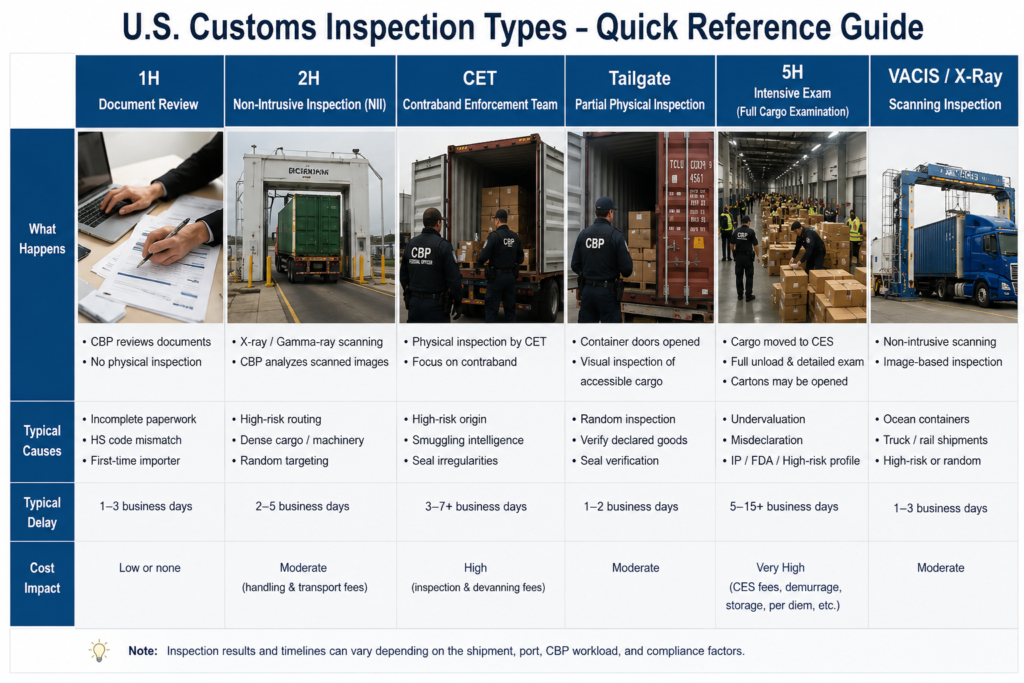
VACIS Inspection — Vehicle and Cargo Inspection System
VACIS is one of the most common scanning technologies used by CBP.
What Happens:
Containers pass through a large imaging scanner without opening the cargo.
Advantages:
- Faster than intensive exams
- Less cargo damage risk
Common for:
- Ocean containers
- Truck cargo
- Rail shipments
FDA Hold vs Customs Exam
Many importers confuse FDA review with CBP inspection.
However, they are different processes.
FDA Hold
Triggered by:
- Food
- Cosmetics
- Medical devices
- Supplements
- Chemicals
The FDA may:
- Request product testing
- Review labeling
- Verify manufacturer registration
CBP Exam
Focused on:
- Customs compliance
- Security
- Trade enforcement
A shipment can experience both simultaneously.
How Importers Can Reduce Inspection Risk
Although inspections cannot be completely avoided, importers can reduce risk by:
1. Using Accurate HS Codes
Incorrect classification is one of the biggest triggers.
2. Declaring Real Cargo Value
Undervaluation attracts enforcement attention.
3. Maintaining Consistent Shipping Records
Frequent changes in importer, consignee, or manufacturer data increase risk.
4. Avoiding Generic Cargo Descriptions
Descriptions like “accessories” or “parts” often trigger scrutiny.
5. Working with Experienced Customs Brokers and Freight Forwarders
Professional compliance support helps reduce filing errors.
Final Thoughts
U.S. import inspections are becoming stricter in 2026, especially amid rising trade enforcement, tariff monitoring, and supply chain security concerns.
Understanding inspection codes such as 1H, 2H, CET, Tailgate, VACIS, and 5H can help importers better prepare for delays, costs, and compliance requirements.
For international shippers, customs compliance is no longer just a paperwork issue — it is now a critical part of supply chain risk management.
Companies that proactively improve documentation accuracy, importer compliance, and cargo transparency will be better positioned to avoid costly disruptions at U.S. ports.