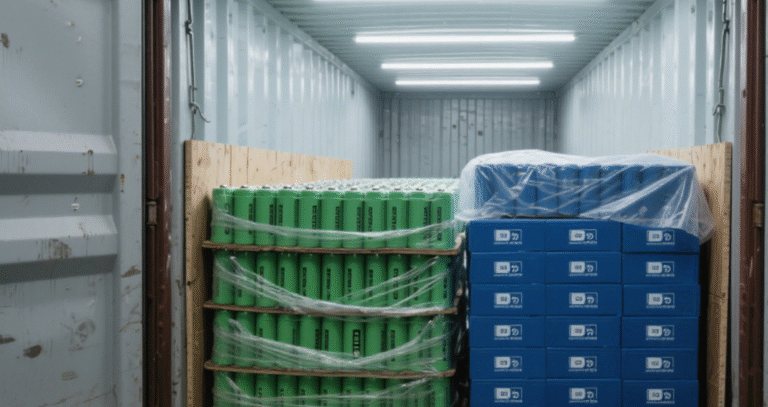
Quick Reference Table of 27 Types of “Battery Dangerous Goods”
By checking against the UN numbers in Chapter 3.2 “Dangerous Goods List” of the UN Model Regulations on the Transport of Dangerous Goods, there are 27 dangerous goods whose proper shipping names contain the word “battery.” Each of these has its own unique UN number—think of it as the “ID tag” for a battery—playing a crucial role in safe and compliant transportation.
| UN Number | Proper Shipping Name | Class or Division | Subsidiary Risk | Packing Group | Special Provisions | Limited Quantity | Excepted Quantity |
|---|---|---|---|---|---|---|---|
| UN2794 | Batteries, wet, filled with acid, sealed | 8 | – | II | 238 | N/A | N/A |
| UN2795 | Batteries, wet, filled with alkali, sealed | 8 | – | II | 238 | N/A | N/A |
| UN2800 | Batteries, wet, non-sealed | 8 | – | II | 238 | N/A | N/A |
| UN3065 | Sodium batteries | 4.3 | – | I | 306 | N/A | N/A |
| UN3090 | Lithium metal batteries (including lithium alloy batteries) | 9 | – | II | 188, 309, 310, 312, 337, 350 | N/A | N/A |
| UN3091 | Lithium metal batteries contained in equipment or packed with equipment (including lithium alloy batteries) | 9 | – | II | 188, 309, 310, 312, 337, 350 | N/A | N/A |
| UN3148 | Battery-powered equipment containing sodium batteries or packed with sodium batteries | 4.3 | – | I | 306, 313 | N/A | N/A |
| UN3166 | Vehicles powered by flammable liquid or flammable gas, or powered by both flammable liquid or gas and fuel cells | 3/2 | – | II | 315 | N/A | N/A |
| UN3171 | Battery-powered vehicle or battery-powered equipment | 9 | – | II | 315 | N/A | N/A |
| UN3292 | Fuel cell cartridges | 9 | – | III | 316, 350 | N/A | N/A |
| UN3293 | Fuel cell cartridges, contained in equipment | 9 | – | III | 316, 350 | N/A | N/A |
| UN3294 | Fuel cell cartridges, packed with equipment | 9 | – | III | 316, 350 | N/A | N/A |
| UN3335 | Lithium-ion batteries, damaged | 9 | – | II | 317 | N/A | N/A |
| UN3336 | Lithium-ion batteries, discharged | 9 | – | II | 317 | N/A | N/A |
| UN3359 | Sodium batteries, damaged | 4.3 | – | I | 306, 317 | N/A | N/A |
| UN3360 | Sodium batteries, discharged | 4.3 | – | I | 306, 317 | N/A | N/A |
| UN3476 | Battery modules or battery pack modules, wet, filled with acid, sealed | 8 | – | II | 238 | N/A | N/A |
| UN3477 | Battery modules or battery pack modules, wet, filled with alkali, sealed | 8 | – | II | 238 | N/A | N/A |
| UN3478 | Battery modules or battery pack modules, wet, non-sealed | 8 | – | II | 238 | N/A | N/A |
| UN3480 | Lithium-ion battery packs (including lithium-ion polymer battery packs) | 9 | – | II | 188, 309, 310, 312, 337, 350 | N/A | N/A |
| UN3481 | Lithium-ion battery packs contained in equipment or packed with equipment (including lithium-ion polymer battery packs) | 9 | – | II | 188, 309, 310, 312, 337, 350 | N/A | N/A |
| UN3536 | Lithium battery packs contained in cargo transport units | 9 | – | II | 188, 309, 310, 312, 337, 350 | N/A | N/A |
| UN3551 | Sodium-ion batteries | 9 | – | II | 310, 312, 337, 350 | N/A | N/A |
| UN3552 | Sodium-ion batteries contained in equipment or packed with equipment | 9 | – | II | 310, 312, 337, 350 | N/A | N/A |
| UN3556 | Vehicles powered by lithium-ion batteries | 9 | – | II | 315 | N/A | N/A |
| UN3557 | Vehicles powered by lithium metal batteries | 9 | – | II | 315 | N/A | N/A |
| UN3558 | Vehicles powered by sodium-ion batteries | 9 | – | II | 315 | N/A | N/A |
Example:
For a common silver oxide zinc-air battery, such as model SR626, the “S” indicates a silver oxide zinc-air battery. This type is considered general cargo and can be transported following ordinary cargo procedures and requirements.
However, for a lithium manganese battery such as model CR2450, the “C” indicates a lithium manganese battery. This falls under Class 9 dangerous goods, with UN number UN3090. Transporting such a battery requires strict compliance with Class 9 dangerous goods transport regulations—such as providing the necessary transport documents and using compliant packaging.
Therefore, before exporting batteries or products containing batteries, it is essential to carefully compare with this table to identify the correct UN number and classification. Accurately understanding the hazardous characteristics of your goods ensures the selection of the appropriate transport method, preparation of complete documentation, and avoidance of delays, customs inspections, or even safety incidents caused by misclassification.